Sunday, January 29, 2012

Where Things Actually Are — The Descendants

"We are not immune to life," says Matt King, referring to people who live in the seeming care-free tropical world of Hawaii. 

DEPTH: 3.5
ACTING: 4
PLOT: 4
ORIGINALITY: 4
PRODUCTION: 5
ENTERTAINMENT: 3.5
DEMAND ON VIEWER: Mild
OVERALL: Recommended

So describes the Hawaiian tone poem of The Descendants. "Tone poem" is literal — by it I refer to both the soundtrack that is a special highlight of the film, and the location-specific environment that feels organic and realistic, capturing a moment much like impressionistic painting or Debussey tone-poems.


King (Clooney) is the wealthy and genuine but relationship-starved man who must come to terms with where things actually are on the ground with his two daughters, now that his wife is hospitalized with a coma.  


The way he must fine-tune his approach to his prickly daughters and ultimately make a decision about what kind of "descendants" they are going to be, is the contribution this film makes to understanding the human condition. He also confronts his own family ancestry, especially the assumptions they have about money and family land, in a really interesting character development of his own role as a descendant.

But by far the best thing about this film is—Shailene Woodley! As Alexandra King, she is pitch-perfect with the complex and mature adolescent emotions associated with her mother's affair and impending death. Ms. Woodley deserves recognition for her supporting role. Honorable mention to Nick Krause as the hilarious Sid. The levity he provides is a much-needed counterbalance to Clooney.

Oh, and George Clooney is pretty good too, though not half as convincing as a few dozen other actors could have been in the role. He blends the comic and tragic well, especially with his clumsy gait as he frantically runs to the neighbors. His depressed self-serious investigation of his wife's affair has the air of the pitifully ridiculous.
Solid story, but no Oscar here from Deeper Film. The story is a bit too average in its approach to the affair and the oh-so-typical contours of the expected fallout. But the way it deals with being more open to one's children as being capable mentally and emotionally of dealing with life, even at its most tragic and painful, is enriching and worth seeing.

Take a mini-vacation to Hawaii by seeing this film, and you'll certainly come out more edified as a person in the bargain, and you might even see your own descendants in a new light.

Sunday, January 8, 2012

OSCAR PICK — Best Actor — Tinker Tailor Soldier Spy

View Trailer


When Gary Oldman sits down at the head of the table, we had all better sit up a little straighter. His performance is Oscar worthy, and Deeper Film gives him Best Actor.


Depth: 4
Acting: 5
Plot: 4
Originality: 5
Entertainment: 3

Demand on Viewer: High/Difficult
Overall: Recommended


I've never seen anyone able so thoroughly to portray a character as Gary Oldman. This film, if nothing else, is a showcase for his talent, at long last. It helps that he is surrounded by a fine supporting cast a mile long, and that the directorial decisions in the film are atmospheric and finely tuned.


The strength of this film lies in its oblique indirectness. It feels very European in that way, and appropriately so, as it is set in Britain during the cold war. The panelled, dark rooms, mundane offices, and crisp overcoats speak of military-industrial complexes and back-room espionage. But for American filmgoers the oblique storytelling may be a bit much: very demanding on the viewer to ascertain what is happening in each scene and why, as well as how it relates to the rest of the plot.

Like a russian doll, stories inside of stories are revealed, told by this character and now that, until one begins to lose track of what might be real and what might be fabricated. This is a thoroughly postmodern device and a rather surprising one to have been employed by a novel written in 1977.

(Incidentally, John Le Carre is a pen name for a man who observed much of the spy-content in real life. I'll leave that interesting sideline for other bloggers. )


Tinker Tailor sustains a literary ambiguity usually only found in books. The ambiguity strikes at the heart of every scene, every dialogue, every action. One is constantly wondering whether there is a double-entendre being played. To be able to see well through such double-lenses is the  talent of the spy, but rather than being adventurous, it is one we see here depicted as hidden behind patience and a dry tick-tock sense of life's passing.

Through his seasoned self-control, Oldman's character Smiley catches a mole. However, there is no glamour to Smiley's achievement: a throne in a padded cell inside a trailer, inside a dreary industrial building, inside a dull and paranoid institution. Smiley is been shown to be ruthless when he needs to be: one has to wonder just how much he was aiming at the top post from the beginning. 

And he is preoccupied with the question, "Did they say anything about me?"  Perhaps this was simply lack of confidence, but the tone of the film is so amoral that one questions whether Smiley's motives were pure. Did the foreigners have a reason to ask about Smiley, say, because he was also a mole? Just how much of what transpired did so at Smiley's behest? The film only hints at possibilities here.

Smiley's self-image had been shattered by the behavior of his wife. Britain itself is on the dock for a crisis of self-image, as the real impetus for the Soviet Union's actions was to lure the United States. The mole says, in explanation of his actions, "I have made my mark." That is the psychological worry of Britain (at least in the film): are they only second fiddle to the U.S.? 

There are many more aspects of this rich film, by turns intriguing, confusing, and puzzling. It is worth seeing at least twice, not least for its visual poetry and pairing of sound with vision. Some of the most difficult scenes toward the end are paired with the lightest fare musically, a strange juxtaposition that further increases the sense of distance and ambiguity between the viewer and the characters.


It seems to me that the psychological need to be heard, recognized, and loved is the film's deepest aspect. (Colin Firth and Mark Strong bring this out marvellously.) In pursuit of those things we may be led into dingy, gritty places. We may even spy. 

Or, we may be forced to do like Gary Oldman does so terribly well—stare blankly ahead while our minds calculate and our emotions boil. In all, a demanding film worth the extra attention span needed to follow it, and here's hoping for the Oscar.


Saturday, December 17, 2011

Start Fresh — Waitress

START FRESH! This one is destined to be a closet classic.


DEPTH 3
ACTING 4
PLOT 4
ORIGINALITY 5
PRODUCTION 3
ENTERTAINMENT 5
DEMAND ON VIEWER: Easy
OVERALL HIGHLY RECOMMENDED. 
This is a fun film for most ages and a great date flick!


Owner Joe's words, "Start fresh," come as a welcome tonic to the beleagured waitress Jenna, played endearingly by Keri Russell in this colorful film about relationships, affairs, and pie diners.


Jenna makes pies. Every emotion, every situation can be expressed in a pie. There's the "I hate my husband pie" and a dozen others shown lovingly made in the story. There's a reason she hates him: Earl, played by the eminently convincing Jeremy Sisto, is one of those moron husbands you love to hate.


Contrast him with the charming and easily lovable Dr Pometter (Nathan Fillian), and you have the chemistry for a great storyline, complete with sarcastic commentary by diner owner Joe (Andy Griffiths), and salted with the other waitresses' flings and love pursuits.


Cheryl Hines, Keri Russell, Adrienne Shelly
The real-life untimely death (see NYT story) of actress and director Adrienne Shelly brings an interesting and nostalgic element to the film. I wish she could have made more films like this one. Its unusual blend of humor and deep emotion is rare.

The film presents a harsh and unforgiving working-class world with a light touch, where we can cheer for the underdog and enjoy a sexual tryst with Jenna and then recognize that eventually she must move beyond it and find her true self. That kind of journey is worth any film's and any viewer's time. 

If you love pie, by the end you'll be salivating...

Sunday, December 4, 2011

High Altitude Hubris — Margin Call

Watch the faces. The whole range of human emotions is there, seething just below the conformism of corporate suit-and-tie glass office protocol. Rage, guilt, remorse, greed, raw power, and a deeply inhumane utilitarianism. This is the contribution of Margin Call: a sort of "12 Angry Men" look at how a room full of very powerful people interact and thereby influence the rest of the world.


DEPTH: 4
ACTING: 3.5
PLOT: 5
ORIGINALITY: 4
ENTERTAINMENT: 4
DEMAND ON VIEWER: Moderate

OVERALL: Recommended


This is one of Kevin Spacey's best. The rest of the cast is, well, marginal. Demi Moore in particular is not convincing, either miscast or misdirected or both. Jeremy Irons does well at the aloof, swoop-down-from-the-helicopter heights of arrogance, but otherwise his performance isn't all that memorable.

What I like most about the film is its metaphors. In one scene they stand on a balcony overlooking a precipitous drop. "It's a long way down," one shudders. The impending collapse of the financial system seems to hover with them on that ledge.
The film ends with the sound of a shovel, as Kevin Spacey digs a grave for  his dog. That scene anchors the film in the real world and provides some physical contrast to the high-altitude hubris of the skyscrapers. The film treads a good line here, showing us a personal side of this otherwise un-empathetic portrayal of Wall Street.

Be sure to watch the clip of Demi Moore and Simon Baker in the elevator, with a janitor in between them. The irony here is delicious: it may be the best scene in the film:


Solid plot, great storytelling, and moves along well and gets to the point of the financial crisis: the selling of literally nothing, and the digging of a large grave we are still climbing out of.

Sunday, October 16, 2011

OSCAR PICK — Best Picture — Moneyball

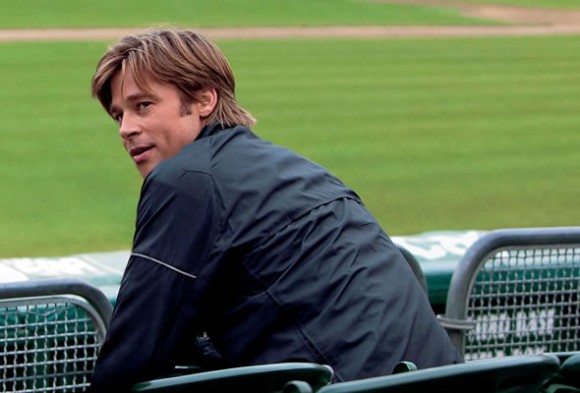
Don't be fooled by the title. This is not really a story about money or even baseball. Nor is it merely about Brad Pitt being a likable cock (though that type truly belongs to him like it used to belong to Robert Redford.) This is a subtle story about finding out who you really are, along with the battles, losses, humiliations, and ultimately the peace of finally coming to terms with yourself.


Depth: 5
Acting: 4.5
Plot: 5
Originality: 5
Entertainment: 5
Demand on Viewer: Mild-Moderate


Overall: Highly Recommended


A relevant and timely premise: what to do about making due? With little resources, and against the establishment belief that the Oakland Athletics are all but a minor league farm team, General Manager Billy Beane (Pitt) is compelled by a passion for baseball and winning to redraw the map. He recruits a shy, pudgy Yale-graduated economist named Peter Brand (played very skillfully by Jonah Hill, whose amusing stoic face is a nice foil for Pitt). Together they pour over the statistical data in hopes of understanding how to maximize his lower-tier recruits. He fields a team of individuals who cannot hit or field as well as any single player recruited by wealthier teams such as New York or Boston. Beane expects that as an aggregate they can beat the odds (a bit like predicting overall traffic patterns in a city without knowing what any individual driver may do.)

So far sounds like a snoozer—something for only "backwards-K" scoring junkies—but be reassured, the film skillfully avoids becoming top-heavy with stats. Indeed, this is one of Moneyball's most remarkable qualities, that it lifts out of this potentially boring subject a deep and lively story about human choices, with plenty of good solid competitive sport sprinkled in for fun. Credit goes to director Bennett Miller and the author of the book on which the movie is based, Michael Lewis.

Start with passion: the gravitational pull of the old way requires a healthy dose of it. Beane has plenty, and it comes out in endearing and idiosyncratic ways: shoving twinkies and popcorn down his throat between phone calls, clicking the game on and off as he pays attention from a distance, wheeling his truck around empty lots trying to clear his head. The most interesting form his passion takes is in the scenes with other people, as he tries to cajole, reason, push, and joke his way around them. A memorable example comes in a locker-room display, when the team, shocked into silence, hears Beane say, "THAT is what losing sounds like."


The opening draft meeting rings true immediately, as a group of seasoned older men tut-tut Beane. Having been in this position myself frequently as a pastor (dreaded "council meetings"), I recognize a universal archetype here: the individual against the (older) institution. There are human tensions created by that relationship that cross all businesses, organizations, and causes. Near the end of the film another team owner expresses this sentiment very powerfully. That dialogue is worth the price of the film, and watching through to that moment promises to be very satisfying.


Against this backdrop and giving the story its profound originality is Beane's relationship to his daughter. He has made choices in his past based on money; now he must come to a different place. The way the film interweaves his own history in baseball with his decisions about his daughter is truly unique. Here is an archetype: a man reflects on past failures and realizes who he is. No tearful scenes, but for those men who recognize their own story, there may be moist eyes.

The performances by Pitt and Hoffman (A's coach Art Howe) are good, though not among their best partly because they have set the bar so high previously. Fortunately they both have the maturity and gravitas to carry off the roles. The movie does suffer a little from their notoriety: one keeps thinking, "That's not Billy Beane, that's Brad Pitt!" However, without their names on the cover, the story might have suffered what the Oakland A's did: de facto relegation to the minors because of lower visibility.

I recommend this film particularly for anyone in a position of leadership or management (the way Beane has to climb all the way down the ladder and understand his players is instructive), and anyone trying to navigate the sometimes impossible straits of family vs. career. Several metaphors, including an especially vivid about one trying to get past first base, highlight these themes in a way everyone can understand and relate to.

Moneyball has moreover something very salient to say to a culture obsessed with both money and sports. As we follow Beane's story, we are led to face several truths about money. It needs to be understood and reckoned with as a controlling force, but ultimately we are free to choose beyond it. Money and sports are only the tip of the iceberg. What does any of this mean? is Billy Beane's question, and one we could benefit from asking more often.

Sunday, October 2, 2011

Climbing Down into the Cosmic — Take Shelter

Do dreams predict? Or are they simply the inner workings of our minds? Is there such a thing as prophetic revelation? Or just another name for schizophrenia?


View Trailer!
DEPTH: 5
ACTING: 4
PLOT: 5
ORIGINALITY: 5
ENTERTAINMENT: 5
DEMAND ON VIEWER: Moderate


OVERALL: Recommended


Take Shelter is a well-crafted story about an ordinary man's extraordinary visionsWhat he sees  are storms: grand apocalyptic warnings about some undefined future.


He decides to take odd preparatory measures, such as building an underground storm shelter and protecting his deaf daughter from her dog. At the same time he seeks help from the family doctor and a local counselor, recognizing that he may have something hereditary. To his own dismay, his inner struggle spills out into his family life and even his community. He is forced to reckon with himself and his fears in unexpected ways. By the end we are left with an uncertain conclusion about the nature of his visions, but certain that they have led him to conquer some of his inmost fears.


The cinematography is gorgeous; the film is worth seeing for that alone. See it on the big screen if you can; the images of the storms are shot to invoke an awesome beauty and power, hard to recapture in a smaller format. During one especially vivid moment in the film, the main character Curtis (Michael Shannon) stands watching a lightning storm paint up the whole sky. He asks, "Is anyone else seeing this?" The answer is a paradoxical yes, because we the viewers do see it, but no one else within the story does. We are brought to feel his isolation and frustration of feeling like the only one given to see clearly.

Michael Shannon's expressive, angular face is memorable as he portrays the crabbed, pensive, and wordless struggle many men have. His character traces what seems often to descend at that time of life: the mid-life-crisis. The story as a metaphor about that transition point, what Richard Rohr calls "the second half of life." According to Rohr such transitions always involve descent: a "climbing down" into ourselves, our deepest beliefs and fears, our family influence, and ultimately our identity and place in the universe. The symbolism of Curtis going into the storm cellar, and of being confronted with the decision to leave it, is a powerful archetype and it gives the film an unusual profundity and universality.


The trouble with the mid-life crisis is this: does it cause a radical change of inner visions or is it produced by those visions? Curtis thinks his visions are objective. He sees his friend try to kill him in one dream, and as a result Curtis takes self-protective actions. The friend turns into an enemy. By believing the prophecy, did Curtis make it self-fulfilling? Or did the dream indicate something already present in the friendship, an underlying cold spot that Curtis could not see consciously? Either way, the film does not let him off the hook; he is held responsible, morally and otherwise, for his response to the visions. 

One of the biggest strengths of this film, paradoxically, is its realism. Its most penetrating and disturbing questions happen to be the least supernatural. What would you do, for example, if your trusted neighbors, friends, and relatives abandoned you or attacked you when, in their judgment, you went outside their accepted norms of behavior? Such "friendships of convenience" can easily collapse under the pressure of values conflicts, broken taboos, or sincere attempt to follow one's (idiosyncratic) dreams. What happens if familial, cultural and societal "glue" starts to be undone by a vision? But this undoing is consistent with apocalyptic prophecy—by its very nature it tends to challenge and threaten the status quo.

"One man's vision is another man's nightmare."An illustration of this prophetic threat and resultant cultural divide happens at an awkward Sunday after-church lunch, when a family member brusquely says, "We missed you at church." By this one brief, very convincing scene, the film manages at once to disassociate Curtis's prophetic revelations from traditional religion, and to introduce the idea of a spirituality not explainable either by science or the institutional church. 

One further great aspect of realism in the film is that it never overdoes the dream sequences. In a way that makes them even more disturbing, the visions are brief, understated, and leave most to the imagination. Little details like the expression on someone's face or an off-color drop of water evoke a terrifying sense that everything is off balance. The rest plays out in reality, through spare dialogue and suggestive devices (the rhythmic sound of the dangerous pile driver, the omnipresence of wind in the trees, ghostly light or reflections coming through windows.) 


I have had predictive dreams.  It is sometimes an eerie and other times consoling experience. For years I dreamt of returning to an office where I had formerly worked, and then it came true in a very unexpected way. I once dreamt about lightning, a wide beam altering everything in its path. Very soon afterward my life exploded with a sudden change (not literally involving lightning, of course). How to explain this? Our minds are capable of many more things than we understand, perhaps even including the prophetic and the supernatural. Take Shelter reminds us of the power of our dreams, the need for careful response to them, and that if we are to be led through difficult storms, it may only be through the cosmic, symbolic and (fearfully) divine language of visions.


Saturday, September 24, 2011

Hidden Inside the Host — Contagion


Contagion resembles the virus that is its subject: if there is a misstep anywhere, it is hard to identify. From the opening scene's unnerving shots of all the things we touch and thereby communicate disease, the visual medium is employed to great effect in service of the plot and message, and this deft and sure handling continues right through to the end. 


DEPTH: 3.5
PLOT: 4
ACTING: 4
ORIGINALITY: 3
ENTERTAINMENT: 5
DEMAND ON VIEWER: Mild

OVERALL: Recommended 


Often when films are as star-studded as this one, everyone seems like they are only trying to out-act each other (a good offender, for example, is the Jack Nicholson film The Departed). Not so in this case. Kate Winslet is plain and even unattractive in many an unsmiling scene, yet still showing remarkable grace in dealing with ungrateful and uncooperative colleagues. 


Matt Damon continues to demonstrate his pliability as a stammering average guy who feels three steps behind an incomprehensible series of events. His display of emotion, when it finally comes, is thus absolutely convincing. 


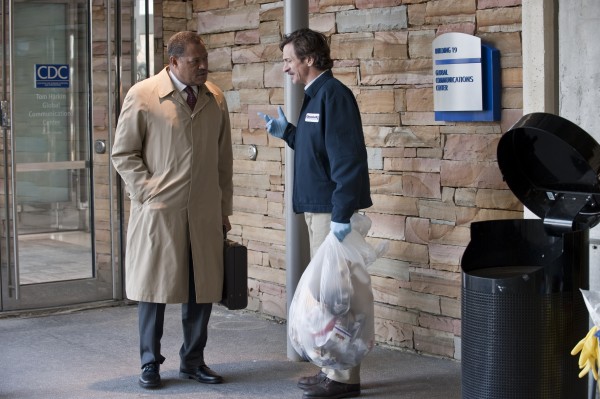
Jude Law and Gwyneth Paltrow contribute much as well, and maybe the most carefully portrayed of all is Lawrence Fishburne's character Ellis Cheever, at the helm of the Center For Disease Control (CDC). 


Deserving of special mention is Jennifer Ehle, who resembles a young Meryl Streep and shows as much finesse, as well as John Hawkes, who completes the circle of understatedness as an unassuming janitor.


The plot is tightly woven and maintains a good balance between global and local perspective. The difficulty is that it is like seeing a well-known play: you already know the plot before you start. Everyone gets sick, and there must be a difficult ordeal. 


One very effective device for keeping tension and surprise within this otherwise obvious and transparent plot structure was to open with "Day 2," keeping the initial contraction part of the investigative diagnostic mystery, hidden until the very end.


Contagion never succumbs to the temptation to portray overly gruesome or gratuitously sentimental scenes. Instead we are brought to a genuine grief over the loss of life and a real fear at the possibility of an outbreak such as this. A remarkable surprise in the film comes after the discovery of a vaccine, as nightmarish scenarios continue to play out in cities unable to cope with basic law enforcement, food distribution.


"How's your Dad?" ":(" Consistent with the realist goals of the film, the texting locates the plot in real time. Simultaneously it develops the agenda of freelance journalist and blogger Alan Krumweide (Jude Law). His message is that the uncontrolled internet is more help to people in a time of crisis than the tightly controlled, traditional and bureaucratic such as the CDC and World Health Organization (WHO). The CDC and WHO are portrayed to regard the internet with the vague suspicion an outdated generation often has for technology and change. The film persuasively argues that the ways our institutions are currently set up to handle a major global disease outbreak are inadequate.


Nevertheless, the people within those institutions are capable of moral heroism. Two touching scenes near the end highlight the selfless sacrifice of the caregiving and medical professions we rely on for help when we are sick. These scenes give the film a human touch and round out the detached clinical side of disease control.


If there is anything that falls a little flat it is the regulatory government-CIA character who interrogates Jude Law, and a perhaps slightly overwrought kidnapping plot line in Macao (maybe a little too close to "24"). 


However, like the virus, these defects are fairly well hidden inside the host of an otherwise great film.