Thursday, October 31, 2013

Elegant Huntress, Nietzschean Warnings — The Counselor

If you think you've seen this tale before, think again.


DEPTH: 4
ACTING: 4
PLOT: 5
ORIGINALITY: 4
PRODUCTION: 5
ENTERTAINMENT: 5
DEMAND ON VIEWER: Moderate to High (extended dialogue featuring complex poetically styled sentences of Cormac McCarthy; judging by the comments posted to the Ridley Scott interview below, this artfulness was lost on some viewers. Very violent and disturbing images, including beheadings, not suitable for the young or impressionable.)

OVERALL: Recommended


This film is a joining forces of two names of wide achievement: Ridley Scott and Cormac McCarthy. Scott's films include Alien, Promethius, Black Hawk Down, and Blade Runner.
McCarthy's books include The Road, No Country for Old Men, Child of God, The Passenger, and All the Pretty Horses
***
***


The pretext for Counselor is a story about a lawyer involved in a drug deal gone bad. But a deeper tale is told here, one about the arrogance of the 1% rich male, whose casual callous bravado is shown as stupidity, and whose sense of control is a complete illusion. (How they got to be 1% is another matter; for some it is financial bullying, others hard machismo, and others a leechy sloth, playing off other people's wealth. The men in this film seem to combine all of these lovely traits.)

Fassbender. Pitt. Bardem. Diaz. Cruz. An all-star cast, and they each do their job well. Bardem and Pitt especially play off previous roles to misdirect the viewer. These are all strong men, and yet they are, one by one, made weak and brought down by a woman who loves to hunt.

The "Counselor" turns out to be the one who needs counsel, and he gets it elegantly from several sources. A diamond-seller (Bruno Ganz), referring cryptically to a gem as cautionary, says, "Why do we adorn beauty? Because we know it is fragile, and yet we also know that this fragility is noble." 

What is this overconfident lawyer to do when he is in trouble? He is already past that crossroads, he is told by a philosophical drug lord (Ruben Blades), and cannot go back and recreate the world that existed prior to his choices. "When you know that your reality must die," he offers, "your view of death changes."

The end is a surprise, because of its quietness, and lack of the usual Hollywood showdown. There is enough fighting, gore, and shoot-em-up to go around, but after so many of the don't-know-when-to-quit variety action films recently, I expected a crescendo rather than a diminuendo to the finish.

The end is also indirect, another welcome change to the usual storytelling methods. There is a CD, but what is on it? The viewer is left to work that out (to its fairly horrible conclusion), but this can only be done if close attention has been paid to the dialogue.

There is a tale here of female ascendancy. The Cleopatra-like eyes of the villain-
anti-hero remind one of the horus-eye, the all-seeing glyph of ancient Egypt, and its corresponding tigress imagery reveals that Mexican cartels and headless bodies are only one way that a cold and calculating, all-seeing eye can wreak revenge. 

Importantly, this tigress also does it with sex. She masters her male victims and slowly strangles them in their own nets. The trip wire is a repeated visual, though used for much more sinister purposes here. People are beheaded and strangled, blood spurting. But far before that, she had already attached herself and wound her way around them. She does the same to the viewer. We at first take her for a bimbo, a party-favor, part of the poolside show. She fucks a car; Fassbender asks, "Why are you telling me this?" Bardem doesn't even know, but he knows he is scared by her. He describes her against the windshield of his car as some sort of sea animal, with suction. This is not simply a circus act. It is what she does.

Is she some sort of avatar for all those who have been taken advantage of by those with power and status? Is she an incarnation of the unholy impulse for revenge? A prophecy of retributive justice against the stupidity of the patriarchal system that includes priests, kings, lawyers, and the doe-eyed women who prop them up? Or simply an acknowledgment of a primal (sexual) urge within all of us for the hunt, something that we as humans never fully escaped from our evolutionary past?

Sam Spruell (tough-as-nails criminal, the one who springs the trip-wire), Bruno Ganz (who played Adolf Hitler in Downfall) and Ruben Blades (reminiscent of the Godfather) all deserve mention for turning in fantastic performances in supporting roles. Without them this film would be less than half of what it is. They give the film its philosophical heft and visceral power; they bring to life Cormac McCarthy's poetry and imagery.

Friedrich Nietzche
Counselor is said to be Nietzchean and nihilistic. It is true that the characters' viewpoints are amoral, and McCarthy's work clearly trends that direction. (Unlike so many movies lately with trite titles such as "Into Darkness," this one really is about the darkness, and about our greed and the choice to enter that darkness.) 


Nietzche's Beyond Good and Evil and Thus Spake Zarathustra are meditations on what it might mean to honestly re-create our values as human beings. What must be rejected and destroyed, in order to get there? This is more than mere negation of value; it is the encouragement of honest engagement with our values. 

Perhaps we do not have to do the destroying; those who choose the path of darkness will destroy their own. Ultimately we are spared the brutal dire consequences that the characters in the film face. We are left to walk out of the theater, out of the story, to re-enter a world of our own choices, seeing that they still lie before us. In this sense Nietzche still speaks to us through films and stories like Counselor. Can we hear what is being said, or do we ignore it and go about our business? Cormac McCarthy and Ridley Scott at any rate seem to be saying, take heed.


Tuesday, October 8, 2013

A Tangle of Dazzling Complexity—Dimensions JDIFF Screening

**JDIFF SCREENING EVENT** At Eronel, Thursday Oct 17, 7pm

A man dances at the edge of a dark hole. "I know, deep down that if I don't do this, I'd never be able to truly live my life. I'd always feel like I'm not really here, like I'm in a dream."

DEPTH 4
ACTING 4
PLOT 4
ORIGINALITY 5
PRODUCTION 5
ENTERTAINMENT 4
AESTHETIC/VISUAL 5+

DEMAND ON VIEWER: Mild-Moderate. Slow, very quiet, English film. 
OVERALL: Recommended


So begins the oblique storytelling style of this atmospheric and very literary film, combining elements of English countryside, dapper period costume, mysterious time travel, and a restrained but powerful love story. 

A jump rope is used to show how time can fold back on itself
Stephen (Henry Lloyd Hughes) is an inventor obsessed with time travel; he has lost a childhood friend, Harriet (Hannah Carson) and wishes to go back and rescue her. Annie (Olivia Llewellyn) helps him on his way. Could she somehow be Annie? There are enough parallels between them to get Stephen wondering.

The machine he builds is made, interestingly, with a piano. The elemental quality of music is alluded to as a possible key to time. The haunting score
is very appropriate here; the strings play hovering chords, suggesting the larger cosmos turning.

The film avoids some of the usual traps and cliches of the genre. Almost all plot and theme development is accomplished through the dialogue, with very careful and exquisitely shot visuals between. Very literary and appreciable by children (good for attention span development and vocabulary, and features children as characters. It hooked my kids from the beginning!)

Dancing through his three-dimensional string map, Stephen seems to show us that no left-brained, linear exercise in mathematics or physics can lead us where memory can only go. He and Annie go through a beautifully rendered waltz through the same map. Their connection seems to indicate the need to pay attention to our present circumstances, and our present loves, even while knowing that they are transient and part of a fragile web of possible futures.

"I don't believe that time is a straight line from point A to point B. It's a line, a loop, a tangle, a sculpture of dazzling complexity." The end of the film leaves us with much to ponder, about the nature of time and reality, and whether or not Harriet's future remains unchanged or is altered by events and time-traveling interventions. There is delicious ambiguity here; if we expected a neat and tidy explanation, we will have been disappointed.

However, if we let the questions of what-who-where-when fade into the dreamy Cambridge countryside as they were seemingly meant to do in this story, we can dwell on the film's themes, and find a remarkable and tragic tale of love and loyalty; lenses through which we can see our own histories more clearly.

Sunday, October 6, 2013

Deeper Series—The Fall

Looking for a series this "fall"? The Fall might just be the thing...


Depth 4
Acting 5
Aesthetic/Visual 5
Plot 5
Originality 4
Production 5
Entertainment 5
Demand on viewer: mild to moderate - story line is easy enough to follow but it is thematically intense and the serial killer element may be too strong for younger viewers.
Overall: Highly Recommended


In the "less is more" mode of British TV series, the five episodes of The Fall accomplish a whole semester of viewing most American series. There is an economy and density of story here that makes each episode like eating fine chocolate. Attention to visual and auditory detail, along with restrained and finely crafted dialogue, makes this series linger in the memory long after it is viewed.

Serial killer Paul Spector (Jamie Dornan) is wreaking havoc in Belfast, choosing a similar victim each time for sexually charged strangulation. A cold, independent, and powerful Stella Gibson (Gillian Anderson) is called in as detective superintendent.

The series departs from the norm in allowing us to get deeply into the life of the killer, as husband, father, and man with a kind of moral compass. His wife works in the birthing unit at the hospital (in diametric opposition to Spector's shadow career as a killer). His daughter can see things in dreams. She renders a drawing of a woman dying with blood all around her, and says she saw her above her room, where Spector keeps his murder diary hidden.

Sexual tension strides through every scene. There is the babysitter for whom
Spector seems genuinely to care, but after she discovers a lock of hair he kept in a drawer, things become dark between them quickly. But the best sexual tension comes from Gibson, as she reacts and relates to the male dominated police and investigation system. One of the most interesting aspects of this film is the way that Gibson's choices as a woman are questioned and brought under scrutiny by her male supervisor (John Lynch).

Eerily, Paul loves to steal into his victims' homes and savor the feeling of control he has by being there, being in the presence of his victim, taking pieces of her, clipping bows off her underwear. He masturbates to drawings and macabre scrapbooking of these images once he gets back home.


Quietness can sometimes hide a deep well of darkness. This is never more apparent than in Spector's
introverted, black-hole eyes. But the same face shows empathy in counseling and we see him in tender scenes with his wife. Is he only a force of evil? We are confronted with our own lack of understanding, even as detective Stella labors to understand his every motive and confront it.

It is a shame that many of the issues dealt with in this series would not likely find as much interest on their own. They have to be set within a crime drama, which makes it seem as though these problems only occur "on TV," or for those who lead lives of extremity.
Primal desires, especially sexual in nature; the double standard women face when it comes to making independent decisions about their sexuality; the uncanny ability of children to perceive what is happening in their parents lives--these issues are well worth exploring on their own merits. Still, the Fall and writer Allan Cubitt deserve kudos for weaving profound and relevant topics into what could have been merely escapist fiction.


Sunday, September 29, 2013

Astonishing Freedom—Happy People: A Year In The Taiga

Live through a vivid, raw, and strangely happy year in remote Siberia.


DEPTH 5
PRODUCTION 5
NARRATIVE 5
DEMAND ON VIEWER: Moderate-High—Subtitled, very slow-paced. Good for watching during a retreat or vacation, when not trying to stay awake after a long day at work, or be overly stimulated
OVERALL: Highly Recommended


Werner Herzog's latest effort is one more in a line of well-crafted documentaries. For this one he and co-producer Dmitry Vasykov travel to the remote Siberian wilderness, and the village of Bakhta, to understand how its people survive the almost prehistorically harsh conditions.

The story opens in the spring, when the trappers are still digging out from under the winter's snows. We see how ingenious traps, boats, skis, and other tools are made with nothing but an axe. As the year progresses through the mosquito-laden summer and into the following fall and winter, we live through a vivid, raw, and un-retouched experience with some amazingly courageous people.
Nothing can get inland to Bakhta, except during the few short weeks when the river is free of ice in the summer. Therefore the townspeople rely on the trappers for their food. The men spend months out in a series of huts which must be maintained throughout the year. The work never stops. Yet these men are not only acceptant of this brutally hard life, they find freedom in it.

There are some very memorable scenes in this story, such as the faithful dog running throughout the night alongside the snowmobile. Dogs feature prominently in the life of the trappers, their only companions. When one of these faithful family members dies, it is a sad thing indeed. We get to hear the vulnerable tale of one such death from the main trapper character.
Another incredible visual, all the more because it is not CGI generated but actual footage, is the moving ice flow of the vast frozen river, just beyond the houses and buildings of the town. 

Roger Ebert called Herzog's voice a "tonic for the soul." Quite so. His accented cadence is almost hypnotic, suitable to the rhythm of the nature he often depicts. The experience of listening to his voice is as powerful as what he describes. You can hear a bit of what I mean by listening to the opening lines of the trailer:

This film is a tonic in more than one way—in contrast to one's own "problems," which will not seem as large after viewing—and as a way of understanding some of the primal, communal drives of the human psyche.

Like going back in time, Happy People takes us into the realm of elemental survival and the astonishing freedom that close connection to nature brings.

Sunday, April 14, 2013

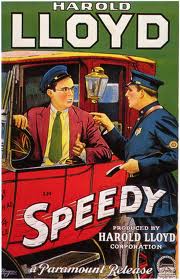
Silent Masterpiece — Harold Lloyd's Speedy at the Julien Dubuque Int'l Film Festival

Taking us back to the innocent and playful origins of film, Harold Lloyd's Speedy is a silent masterpiece of clever theater and hilarious fun.


View 1962 interview with Harold Lloyd, along with several clips of other silent film stars and some discussion of why Lloyd was different from Chaplin.


As the marquee Saturday night event of the four-day Julien Dubuque International Film Festival, Speedy did for the audience what films rarely do: it got them laughing out loud and talking to each other afterward. The sense of community it engendered was as inspiring as it was surprising. 

Set to an original score and meant to be seen with a live orchestra, the story is of a penniless but enterprising working-class person in New York City, a believable character who must overcome financial odds to protect his father's business and win the woman he loves.

His pursuit of work gets him a job driving a cab, which earns him his titular nickname, and gets him into all sorts of trouble. The production quality of the scenes racing through Manhattan is high; they are almost breathtaking and would have been extremely difficult to film.
My children followed the story and most of the humor, some of which is three-stooges style slapstick and some of which is quite subtle and clever.
They especially liked the cameo appearance of Babe Ruth, who acts in remarkably convincing fashion.


View scene with Babe Ruth in cab (it won't be as good here as the live orchestra!)

Speedy works as a film because of its humor, but also in the way it pays homage to New York, and to the underdog. There is a universal story here about struggling with the powers that be, and doing so with flair and grace.

Kudos once again to the the JDIFF for their inclusion of this important piece of film history, and having everyone be so delighted and entertained in the process.


Sunday, April 7, 2013

Vidal Sassoon — The 2013 Julien Dubuque Int'l Film Festival

Sometimes we come across someone who is so inspired, so driven at the core of their being, that they can influence us in an area in which we might not normally have any interest. Such is the case with the seminal persona of Vidal Sassoon (1928-2012).


DEPTH: 5
PRODUCTION: 5
NARRATIVE: 5


This fascinating documentary is a multi-faceted portrayal of a man whose life was dedicated to hair, who gave women a new way of thinking about their own self-image and their very role in life.


The most reproduced image of a hairstyle ever
VS wanted to eliminate the superfluous, get down to the basic. In doing so he created a look no one had ever seen, and one that still looks contemporary.
The 5-point cut


A survey of recent glamor magazines confirms that the 5-point cut design VS pioneered fifty years ago is still alive and even ahead of its time.

"Hairdressing needs to change in response to architecture." VS was influenced by the minimalism and geometry of the Bauhaus school. "Geometry, angles, and shapes must be suited to the bone structure" of the woman's face.

He would convince clients to do things his way, not theirs. "Don't you want to give me what I want?" they would ask. "Listen," he would say, with a whispered, almost hypnotic intensity,
"People who go out on a limb, who really get to who they are, they don't do things the way they were used to."

Haircutting was about liberating the self, allowing one's own inner expression to shine through. It allowed women to escape from the weekly perm-and-puff tending to their hair. Sassoon's influence came to the fore in the 1960's when there were many other movements afoot changing the role of women.

"You can't go through life on a fairy tale." VS's daughter overdosed and died on New Year's Day around five years prior to the documentary (around 2005). He reflects soberly on this downturn in an otherwise star-struck life. VS took lessons from an acting coach, to get over his cockney, to appeal to a wider, more sophisticated audience and clientele. He and his first wife were very good at being on television and eventually found themselves in Los Angeles with a talk show and a $400 million-dollar product line to market.
The move to L.A. and the plunge into product sales was "good for product, bad for family." This unfortunate story line seems to be so common among those who have his level of energy and creativity - one wonders why this has to be so. He reflects that he went away from what was truly at the core: cutting hair, interacting in real time with the living sculpture of a woman's face.

His advice for anyone who is an artist: it will take more time at your craft to master it, even putting in 14-hour days. Nine years of preparation, he says, went into the discovery of the five-point cut. And this: "Most of my progressive thoughts and attitudes happened when I was alone."

He kept very fit; swam and was extremely flexible. He had a generous heart; a surprising moment in the documentary comes in the telling of his finding a way to build 23 homes in New Orleans after Katrina.
The energy flowing from the Vidal Sassoon salons—originally just one in London, then in New York, now around the world—has influenced a generation of stylists and teachers. He touched the lives of countless women who discovered new way of looking at themselves, their own potential.

The world was richer for his life and presence, and one cannot but come away from this inspiring documentary with a sense of optimism and renewed dedication to their own potential.

We might see our image in terms of our hair, but perhaps more importantly, we can see it whatever craft we might be pursuing, and give to the world as he did.