Friday, February 1, 2013

The Veracity of Self—Life of Pi

Ang Lee has given us a film for the ages, fitting for our century, and it will be remembered for its vision, veracity, and honesty, particularly about god and religion.

DEPTH: 5
ACTING: 4
PLOT: 5
ORIGINALITY: 5
ENTERTAINMENT: 5
PRODUCTION: 5
DEMAND ON VIEWER: Mild (some scenes may startle children)
OVERALL: DO NOT MISS THIS FILM! HIGHLY RECOMMENDED!


For all the reasons already given by others—its use of 3D technology in a balanced, sophisticated way, its breathtaking artistry, its surround-the-viewer with an ocean adventure sweep—Ang Lee's Life of Pi is a good film. But these things by themselves do not make it the masterpiece that it is.

Pi is a timely film about all of the Big Questions: the meaning of suffering, religions and god, and the stories and myths we tell ourselves as a human race in order to survive and flourish. It pits us face to face with a natural world that is both stunningly beautiful and horrifically dangerous. It asks us to examine just why we are on the journey we are on, and whether god is really at the heart of it.

Piscine Molitor Patel is an inquiring boy who is open to the contribution of religion (over and against his family's barbs at the dinner table). He explores Christianity, Hinduism, and Islam, feeling devoted to them all. At the same time he introduces us to a world of sound and color in India, where dance forms and family customs are not our own. So there is at the outset a very global, diverse feel to the story.

Pi is an emotional film, but its emotion is genuine and not gratuitous or manipulated. The tiger is not a pet; it is a danger constantly, and there is a message about not sentimentalizing nature here. The tiger leaves without a word, even after Pi has done so much for it. Pi's heart is broken over this; and words from his father echo from the beginning of the story: "The tiger is not your friend." For a film with a clear love of animals and of their grandeur, this is a remarkable and unusual twist.

Pi is a call to bravery. My sons saw the film and had to be brave along with Pi during the story. They are not ready to digest the meta-narrative about religious story-telling, but they could understand that Pi held out through unbelievable odds. This kind of virtue-instillment is an important feature of film. Good films help encourage us to keep persevering under great stress; they help us to see that the turns of fate will be as fortunate as terrible, and that we can find and redefine ourselves in that struggle.


***SPOILER ALERT*** Please, if you have not seen the film, stop reading here, and go experience this film for yourself.

The adult Pi (Irfan Khan) explains to a journalist (Rafe Spall) that by the end of the story, the journalist (and by extension, we the viewers) will believe in god. This is a brave gauntlet to throw down at the beginning of a film. I worried throughout that by setting itself up in this way, it could only disappoint in the end, either by becoming all about proselytizing a religious view, or by simply biting off too much topically.


At the end of the story, Pi relates a harrowing tale, one that was far less beautiful and far more traumatic. Rather than being trapped at sea with animals, he had been trapped with his family and an evil, cannibalistic cook.

(An earlier scene in the film becomes an important touchstone at this point, when that cook was shown to be a mean and miserly person. Gerard Depardieu's face was so memorable that even though he does not appear again, mention of the cook works to recall this scene. A fair bit of expert storytelling here.)

The cook kills his family in order to survive at sea; Pi is forced to watch his mother devoured by sharks. He makes up the images of the animals to stand in for these people. The hyena that so unceremoniously kills the monkey and the zebra on the lifeboat is the cook.

The conclusion is inescapable: "So you are the tiger?" the journalist asks. The tiger was a self-projection of Pi's. A way of making sense out of a reality his mind could not grasp in its shock and trauma. "Which of these two stories that I have made up, do you prefer?" Pi asks. "The one with the tiger," says the journalist.

Pi concludes: "So it is with God."

This is perhaps the best, simplest, and kindest treatment of the explanation for religion I have ever seen. What gives rise to the religious and mythmaking consciousness of humankind? Why do we desire it? Our desire for paradise is literally represented in the film by a magical island, the island that Pi finally arrives at after being driven to the depths of his being, after praying mightily to god to save him. Yet the island turns out to be poisonous. "What it gives during the day, it steals back by night." This is a singular and stunningly astute commentary on Pi's own religious motives: he was looking for Eden, and yet finally realized he had to leave it, that he was on his own. What religion purports to give on the one hand by way of comfort and explanation, it steals back on the other by weakening the mind and soul, making it dependent, leeching energy while it promises security. We must leave it or be slowly poisoned by our own fantasy.

The tiger walking away without a word of goodbye is heartbreaking because it is Pi's own former self, the one that he had to call upon in order to survive such an ordeal. The wild tiger, one with nature, fierce and able to brave anything, is gone now that Pi is back in civilization. But in another sense, this represents the grief that humanity in an age of enlightenment must face, as it sheds its religious illusions and moves to a higher plane of consciousness.

The fact that Ang Lee captured all of these themes in a simple story viewable by children is astounding. We hope this film garners many awards, as it deserves to do, and that Yann Martel also gets credit for telling such a remarkable tale. They have once more elevated storytelling to the art form it aspires to be.


Life of Pi helps us, ever so gently, to revise our view of our own religious stories, admitting as Pi Patel does that we love them and that we invented them because they are prefereable to the mundane and brutal reality we face. In this sense Pi's coming of age is something we must all go through. In doing so we will suffer. We will be brought to the edge, but there we can achieve a veracity and luminosity of self, represented by all the fiercest and most phosporescent images of this film. Like the whale in the ocean at night, we can see our soul before us, and truly possess its infinite beauty and strength.

Monday, January 21, 2013

Grit and Gristle of Love — Rust and Bone

Rust - the creaky underside of things, the sense of aging, of loss, and the label for something no one wants. Bone - the thing that gets broken, in fighting, in loving, in the process of living.


DEPTH: 4
ACTING: 5
PRODUCTION: 5
ORIGINALITY: 5
ENTERTAINMENT: 4
PLOT: 5
DEMAND ON VIEWER: Moderate
OVERALL: Recommended

A memorable and unlikely title for an unlikely pair in this film. Both terms indicate the grit and gristle of the love story in this film, about struggle, loss, and a very physical brokenness followed by healing.


Jaques Audiard gives us a visually stunning and originally told story, with a wide range of images from the quiet and sublime to the violent and gritty, which induce a rhythmic, hypnotic effect. Yet somehow the story also stays grounded, never leaving the practical, the flesh-and-blood, and the honest cause-and-effect of choices.

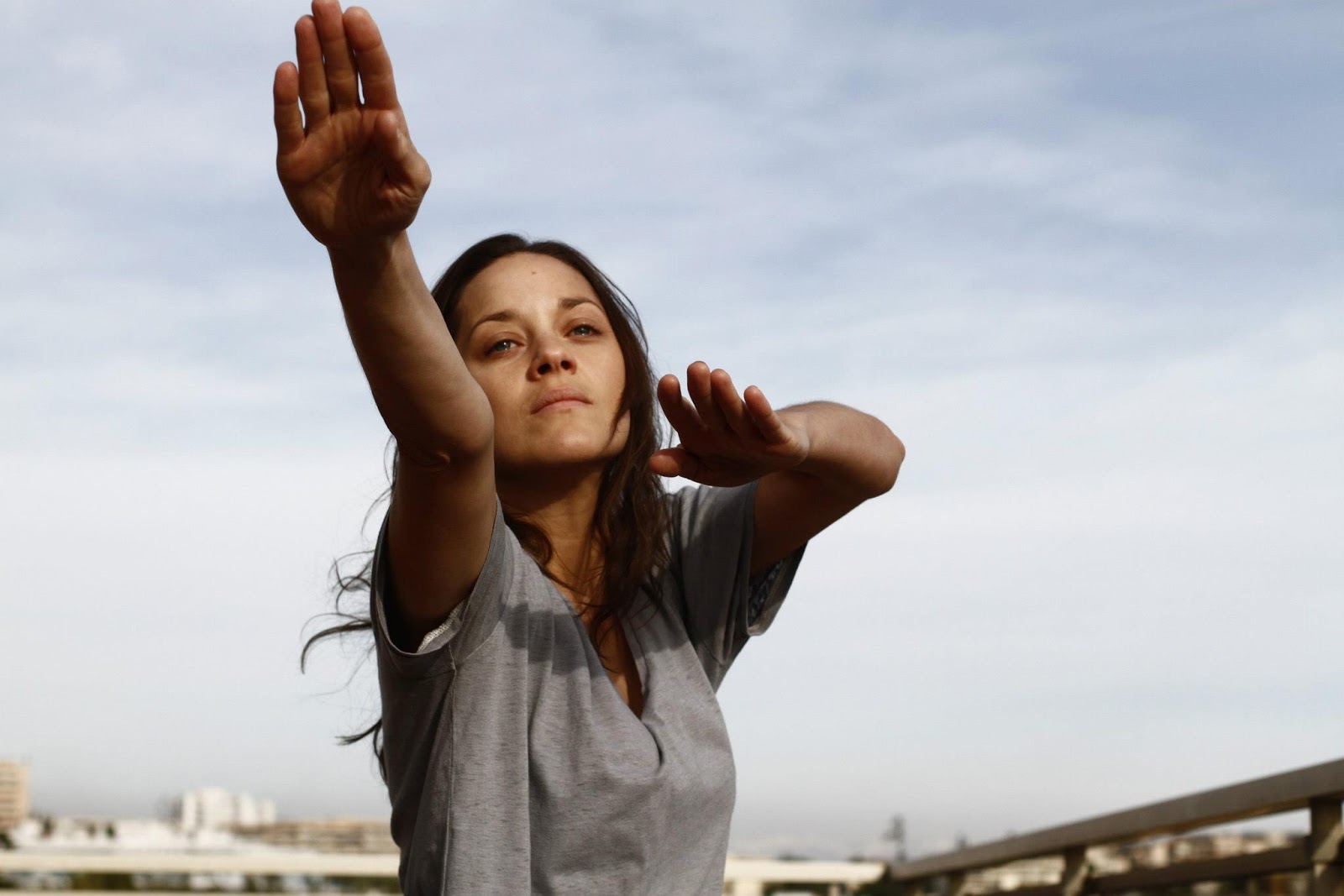
Marion Cotillard delivers an Oscar-worthy performance as Stephanie. At first plucky and energetic, Stephanie's loss of her legs plunges her into an eye-sunken depression; she must be rehabilitated by Matthias Schoenaerts' character Ali. Cotillard portrays this arc with unnerving accuracy, going from headstrong to immobile, from self-doubting back to confidence. Both her missing legs and the wearing of prosthetic limbs were done with painstaking care.

Ali must keep ahold of his son. His story revolves around a messy world of street fighting and shady back-room money-making, ostensibly to take care of his son, but also to feed his own immature sense of manhood. He breaks his hands on other men's jaws—another kind of disfigurement—but eventually he must channel his instincts in a better direction.

Stephanie does not judge Ali for his primal instinct to fight; she respects it. She is extremely tough, and in this way she affirms herself and him. She calls him out on his immaturity with women, but he is nearly deaf to what she says. Yet he comes around. He realizes, in a climactic moment achieved with a hushed but intense whispered cry over the phone, that he loves Stephanie and does not want her ever to leave. This is the deepest kind of love, born of mutual loss and unbelievable struggle, and the respect each has for the other's pain.

The bulk of the orcas was fearsome. The cinematography of the orcas was an absolute highlight: an earthquake-like accident, with whole pieces of a platform falling into the water in a cataclysmic scene. This is balanced by the healing and dance-like exchange between one of the whales and Stephanie near the end.


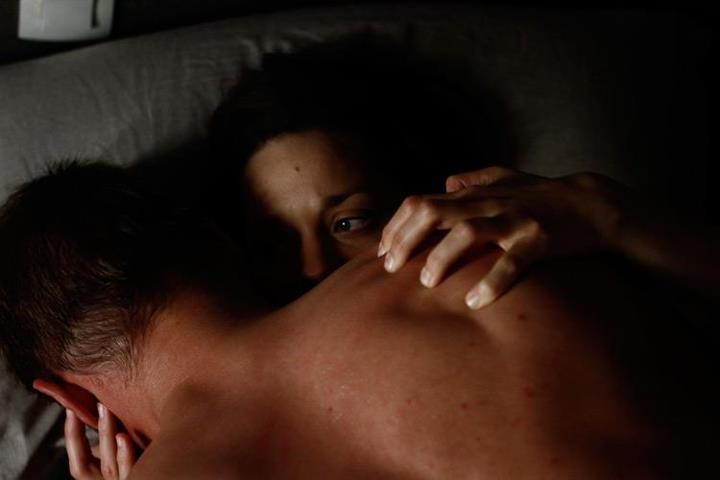
The sex is excellent, not because it is graphic or especially titillating, but because it honest, real, and done with full view of Stephanie's deformed body. After her sexual encounters with Ali she is able to recover her sense of herself and even go back to the site of her accident and her former career as a dolphin trainer. Through her healing process we are shown how our sexuality can help bring us back from despair, and we are shown how a disability does not detract from sexuality.

Rust and Bone is a very moving film about healing through pain and struggle, and about affirming ourselves rather than wallowing in guilt or shame as we move through our worst mistakes and losses. No metaphysical or religious answers are given for the suffering we go through. But it is a meditative film on the body, its power and its longings, and its connection to our consciousness. This film will be remembered for its contribution to the understanding of the human body and its capacity, no matter how beaten down or disfigured, to recover and to bring with it the human spirit.

Friday, January 18, 2013

Rise of a New Way—Zero Dark Thirty

"I am the motherfucker who found this place."


DEPTH: 4
ACTING: 3
PLOT: 5
ORIGINALITY: 4
PRODUCTION: 5
ENTERTAINMENT: 5
DEMAND ON VIEWER: Moderate
OVERALL: Recommended


It is not too soon for this film. About more than Osama Bin Laden, about more than Barack Obama, more than 9/11, more than military tactics, more than an individual's courage in the face of overwhelming odds, Zero Dark Thirty is about the rise of a new age, one where the leadership of women makes the difference.  

Jessica Chastain, as CIA operative Maya, in a iron-hard performance of grit, courage, determination, and intellect suberbly delivers that surprising line—I am the motherfucker who found this place— in front of a cadre of stiff suits in the White House around a model of Bin Laden's compound in Abbottabad.


Maya convinces her colleagues and ultimately the rest of the world that she had found her target. More than that, she convinces the men in positions of influence to set their careerism aside and focus on the thing that most needs doing.

Jason Clarke begins the film as the ruthless interrogator Dan, and while Maya has a hard time stomaching his practices, she is a realist and does not back down. She outlasts Dan psychologically, staying on after he moves to back to Washington an inner poise and endurance even greater than his.

Let us not miss the point about torture: it is a merciless practice. We are asked in the film to weigh it. And yet, there is real movement in the film away from torture as the story progresses. The CIA is forced to find other ways to get their information, and respect the far less gladiatorial but more quietly persuasive ways of Maya. I find it completely mystifying why Bigelow is being taken to task over this. Perhaps a more careful viewing of the film is in order.

One of the unique features of the film is that while we know the ending, we do not know the result of the penultimate plot. The location of Bin Laden's courier was won with the sacrifice of lives. This creates terrific tension in the film, right up until the actual capture. The final scenes are depicted with an honesty (how could they have crashed a helicopter?) and a rhythm that has the heart beating well after the film.

Zero Dark Thirty reminds us that we are truly in a new age, one where tactics like waterboarding begin to take a back seat, and where the good-ol-boy institutions are not effective anymore on their own, one where a woman can not only lead soldiers, but lead using every device, keep everyone focused on the goal to the exclusion of all else, and experience the utter loneliness of that kind of leadership.

It was a real goal, not a fantasy. One that was really accomplished, not just dreamt about, by a woman in the prime of her career. This fact makes the heroism and suspense of Kathryn Bigelow's film a sharp and poignant commentary, one every American should see.


Sunday, October 21, 2012

Ego and Id—The Master

An exceedingly strange, thrilling and disturbing film, The Master is a like a dark pool, mysterious and rippling with refracted light, now revealing, now concealing what it is really saying.


View Trailer

DEPTH 5
ACTING 5
PLOT 5
ORIGINALITY 5
ENTERTAINMENT 4
PRODUCTION 4

DEMAND ON VIEWER  High (length, non-linear, and difficulty of comprehension)
OVERALL  Selectively Recommended (this is not a film for those who want a straightforward story or a feel good.)


Playing the dark, base, animalistic persona of Freddie Quell, Joachin Phoenix upstages even the inestimable Philip Seymour Hoffman as he turns out a singular performance with a character as real and as unforgettable as his other two major roles in Gladiator and Walk the Line. There is constant tension in the film based on the unpredictability of his character against the formal, high-society cult that has been built by Lancaster Dodd (Hoffman).

Quell has something like post-traumatic stress disorder from serving in the war. He goes from job to job, getting in trouble by reckless behavior such as mixing alcoholic drinks using paint thinner and poisoning people. He happens by a boat with a group of high-class New Yorkers, and is welcomed by their leader, Dodd.

Immediately there is chemistry between Quell and Dodd; one of the fascinations of this film is to ask why this is so throughout the course of the story. Is Quell the Id to Dodd's ego? The animal to Dodd's spiritual nature?


Dodd loves Quell's alcoholic drinks even while maintaining that Quell is "naughty" and should stop boozing. Quell in turn loves Dodd's repetitive questioning process. Based loosely on scientology, it is evidently aimed at the recovery of memories and past lives. It seems to help Quell calm down. Close ups of Quell show a haggard and lined face becoming smooth again. But ultimately Quell cannot be quelled (choice of his name is very ironic.)

At one point Dodd has Quell pace relentlessly back and forth between wall and window as part of the "process." This is frustrating to Quell but ultimately helps free his trapped and repressed guilt over abandoning a woman earlier in his life. These strange encounters permeate the film with a kind of unreal trance-like quality, believable and yet at the same time alien.


In his saner moments Quell is a photographer. His role is (albeit unconsciously) to both document and expose the cult to a harsh glaring light. We see, through Quell's eyes, Dodd's inconsistencies, Dodd's own animal nature, and the ridiculous elements of Dodd's practice. The irony is that Quell is perhaps the least self-aware person in the story, or so it seems at first, and yet he practices great kindness in the end by passing on some of Dodd's more positive and helpful questions.


The megalomania of Dodd is both mesmerizing and creepy, and yet at times he seems genuine and effective in reaching an unreachable person like Quell. The two are clearly dependent on each other. It reminds me of Hegel's discussion of the master-slave relationship. One is dependent on the other, and one's very existence arises out of the other's. "I'm the only one that likes you!" Dodd yells as they are both in jail.

The jail scene is the most riveting of the film. I do not know how it was physically possible for Phoenix to ram his body around that cell, slamming into the top bunk over and over, without becoming injured. All the while the "rational" Dodd looks on passively, suavely. It is hard to miss the statement here that these are twin sides of the same character.


Amy Adams deserves special mention. Her performance is a subtle blend of submissive and controlling body language, and her barely contained emotional fervor is pitch perfect for her role as Dodd's wife. She sits in judgment over both Quell and Dodd, introducing another element of mastery—sexual. Clearly Dodd's sexuality is kept in check by her; and her own sexuality is fraught with repression. She seems to be eternally pregnant as well, bringing up the constant presence of that more primal element of society and particularly religion, the guarded use of sex within the family for procreation and protection of the fold.


After an ambiguous scene depicting what seemed to be a fantasy of Quell's, where members of the cult were unashamedly nude during a song and dance session, it is Dodd who gets punished by his wife Peggy (Adams). It is as though Quell and Dodd were collapsed into a single mind, perhaps together with all males, high and low class alike. Dodd is punished in a very challenging scene in the bathroom where Peggy masturbates him and acts the part of an aggressor.

This film certainly helps to explain the prevalence of cults and fanatical movements, but it also helps illuminate the darker (and sexual) parts of our own natures. We all pretend to be rational, but we all have ways of covering over our flaws. We all feel that our own logical positions are airtight, and yet they may be just flights of our own imagination. We think we are in control, and yet Quell is there within, at the edge of our consciousness, waiting to jump out. What issues do each of us face require a master to help us modulate, fix, or move through?

Near the end of the film Dodd says "If you can figure out a way to live your life without a Master, you will be the only human being ever to do so." This kind of line at the end of a film causes one to go back and re-evaluate just what was the subject of the film in the first place. For a society at the edge of evolution, perhaps we are also at the brink of falling overboard, because we do not know ourselves as well as we think. Perhaps we ought to reckon with our sexuality rather than pretending to be "rational" in order to control it. Perhaps it is not so bad after all to be looked after by a Master.

Wednesday, September 26, 2012

Fresh Innocence — Moonrise Kingdom

A dollhouse world more honest than our own.


DEPTH 5
ACTING 5
PLOT 5
ORIGINALITY 5
ENTERTAINMENT 5
PRODUCTION 5
DEMAND ON VIEWER Mild-Moderate 
(Must be patient as story unfolds at a slightly slower pace than many films.)
OVERALL Highly Recommended!


In Moonrise Kingdom we get to see the wisdom and innocence of youth — from the dollhouse opening scene to the boy scout island adventure, from the first kiss to the serious commitment to elope. Wes Anderson has created a magical world that is also somehow more honest and agreeable than our own. Kudos to the adolescent actors Jared Gilman and Kara Hayward (and why don't they get billing on the poster??!!) who carry the film with their unashamed naturalism and grace, and who outshine even the likes of Bruce Willis, Edward Norton, Bill Murray, and Tilda Swinton!


This is good storytelling and finely crafted scenemaking at its best. You will feel better after seeing this, I guarantee it. It has a reassuring quality to it, as though commenting about something way beyond its era (1960s), something having to do with our own time, of rediscovering fresh innocence and shedding the clumsy embarrasment of our forbears.

Below are some examples of the artistically placed scenes, and some of the tropes, such as looking through the binoculars, putting on masks and costumes (and removal of the same, along with clothing), the quirky yet oddly endearing adult habits, and the diligence of the ever studious scout.


See this film! In the meantime, there is another fantastic review of this film at Moving World, a fine film blog that Deeper Film aspires to!

Monday, September 24, 2012

Morality and Sacrifice — The Dark Knight Rises

Much more than your average superhero comic-book film, this one is worth seeing for its moral worldview and its deep character portrayals. 


DEPTH 4
ACTING 4
PLOT 4
ORIGINALITY 4
PRODUCTION 5
ENTERTAINMENT 5
DEMAND ON VIEWER Mild-Moderate
OVERALL Selectively recommended (may be unpalatable for some children)


This movie is a fun, wild ride, and while it has certain deficiencies—most glaringly the absence of a villain as mysterious and disturbing as the Joker—it is a solid capstone on a well-made trilogy, and it offers some powerful lessons in personal sacrifice, virtue and in understanding one's fear.


The production pyrotechnics combine with a solid plot and great character acting to deliver a film in league with director Christopher Nolan's first two installments. Christian Bale, Gary Oldman, Morgan Freeman, Michael Caine — these are some of our best film actors, and any story with them would be worth seeing. This is one of the finest performances I've seen from Caine. Joseph Gordon-Levitt and Anne Hathaway also complete the well-rounded cast, along with a brief return visit from Liam Neeson. Each of these characters comes with a rich and complex worldview that gives them roundedness and solidity, and makes them intriguing to watch on screen.

One thing I really enjoy about Nolan's work is that he can accomplish much within the space of a few minutes, without sacrificing quality or interupting the flow of the story. He achieves a rhythm with carefully edited and precisely calibrated scenes, making them at once more memorable and able to deal with many plots and subplots simultaneously.
  
A surprising and original twist comes in Nolan's combination of batwoman and catwoman into one role. Anne Hathaway delivered this duality perfectly; her presence offered the kind of sexual frisson and moral ambiguity that give the Batman story its edge. With a single look Hathaway can communicate a range of emotional reaction, such as at the unexpected return of Bruce Wayne after his imprisonment, where she makes the shift from her betrayal of him to support and even love.

As for Bane (Tom Hardy), he was simply not scary enough. Nolan did such a fine job of creating the devil incarnate in the Joker, that no future villain could ever match it. Bane is a too-obvious character created to seem invincible. His face looks like a skull, he has a strange voice, he is inhumanly strong, and can affect people by touching them. Still, he came off a bit flat, despite the effort to make him seem complex (as the rescuer of a child from the prison pit). 
Bane is the self-styled representative of the 99% (a surprisingly relevant premise), and the moral lesson of the film centers around this conflict, as Bane takes down the stock market and sets up a kangaroo court. Batman wishes not to resort to violence and anarchy in resolving these kinds of class struggles. Batman is no revolutionary, but he does what it necessary to preserve order. For those who worry that the film is too violent for children, this lesson is quite clear even to children and is actually a memorable way to teach nonviolent resolution of conflict.


The best lesson of the film comes in Wayne's imprisonment. Stripped of his batman armor, he returns to his roots as a person struggling with core beliefs, and living in a very primal state. The scene in the pit recalls the original training sequence in Batman Begins, a nice literary device that makes the story feel contiguous with the earlier films.

Dark Knight Rises offers an important lesson: we must not deny our fear or our weaknesses, but rather recognize their power to connect us to our true humanity, our ability to sacrifice, and get us to do what we thought was impossible for the sake of our common welfare. These virtues are not easily found in films, especially not in this genre. For their effort at putting forth these lessons in an entertaining way, the director, cast and crew deserve accolades, and this film deserves to be remembered.