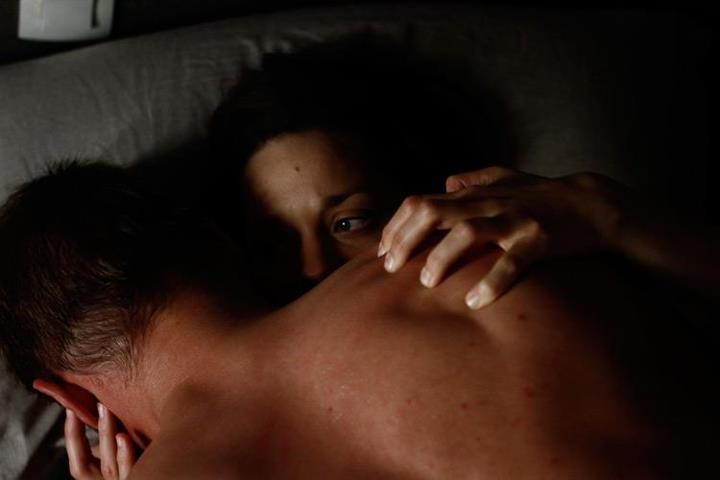
Why would she do it? Why get involved with another man when her domestic life with husband Alessio is secure, loving, tender, full of support and comfort?

DEPTH 5
ACTING 5
PLOT 5
ORIGINALITY 4
PRODUCTION 5
ENTERTAINMENT 3
Don't watch this to see gratuitous sex or to escape from a long day.
Don't watch this to see gratuitous sex or to escape from a long day.
AESTHETIC/VISUAL 5
DEMAND ON VIEWER Moderate
OVERALL Selectively Recommended.
Mature theme, don't watch if you don't want to open the can of worms called "affairs."
This film is a fine example of the material offered by
Film Movement. Check them out!

 "At least there are no vampires here," says Domenico, when they enter the hotel room. (Which they can book for four hours at a time—this European invention is an acknowledgment of the need for a neutral location.)
Vampires indeed—is precisely what they are there to do, the red-lit ambiance giving expression not only to their passion but to the devouring lust at work.
At this point each viewer will read his or her own judgment and history onto the film. But if we can stand back from that, we are led to ask, How do we deal with our bodily chemistry, our emotional pull toward the passion and vitality that can so easily go missing from our secure domesticated arrangements?
What do we do, in other words, when the pulse of sex takes over, and the "logical" parts of brain begin to shut off? When the pre-frontal cortex of brains, the "reasonable" side of ourselves, is revealed for what it is—something of a piece with the lower brain, something that arises out of the unconscious, something that is only a small aspect of our person, not the whole—what are we to do? We don't have as much "choice" in the matter as we might want to believe.

According to one perspective from Slant, this film, while balanced, has its share of cliché moments and characters. I disagree. In fact, it is astonishing to me that the questions asked by this film are regarded as cliché, when the fundamental problem posed is at once so powerful and so intractable, and when I rarely see them handled as sensitively as they are in this film.
If anything, the cliché is not this story but in our conception that romance should only happen between two single people. Escapist romantic comedies abound of that sort. If any of those stories added in the element that one or both parties are married or in a committed relationship, they would at once become heightened with artistic tension.
If anything, the cliché is not this story but in our conception that romance should only happen between two single people. Escapist romantic comedies abound of that sort. If any of those stories added in the element that one or both parties are married or in a committed relationship, they would at once become heightened with artistic tension.
 What I like most about this film is that these are two of the most ordinary-looking people you will ever see on screen. Their ordinariness makes the story convincing, and it lends an especially poignant and even breathtaking quality to their lovemaking. This film is anti-porn, the opposite of the blitzed-up pseudo-world of internet sex, with ordinary people breathing and moving together instead of showing off moves for the camera.
I also like that the momentum of the affair is led in the first place by the woman. She recognizes something in herself that needs expression, but also that the personalities around her in her family are never going to recognize it. She quite bravely pursues her own path (though it must be said that lying about it was not courageous). Eventually she realizes she will not choose to continue the affair. But her choice comes from experience, not from theorizing or moralizing.
The worst part about an affair is the deception. Lying is a kind of poison that slowly worms its way into each relationship affected by an affair, and to Silvio Soldini's credit, he does not spare the characters the emotional consequences of lying.
 Guiseppi Battiston does a marvelous job as the "straight man" to Anna's deviancy. His genuine all-around good-guy-ness, as boring as it is, nevertheless is good for her, and she knows it. Without his character as a foil, Anna's would not stand out so starkly. His grace in handling everything is commendable. Would that we all could get a dose of it.
The worst part about an affair is the deception. Lying is a kind of poison that slowly worms its way into each relationship affected by an affair, and to Silvio Soldini's credit, he does not spare the characters the emotional consequences of lying.
 Guiseppi Battiston does a marvelous job as the "straight man" to Anna's deviancy. His genuine all-around good-guy-ness, as boring as it is, nevertheless is good for her, and she knows it. Without his character as a foil, Anna's would not stand out so starkly. His grace in handling everything is commendable. Would that we all could get a dose of it.
***
 Be sure to see other work from Come Undone actors. Stay tuned, reviews of a few of these films coming soon at Deeper Film!
Alba Rohrwacher
Pierfrancesco Favino
Guiseppi Battiston (gotta love these names)