Sunday, September 29, 2013

Astonishing Freedom—Happy People: A Year In The Taiga

Live through a vivid, raw, and strangely happy year in remote Siberia.


DEPTH 5
PRODUCTION 5
NARRATIVE 5
DEMAND ON VIEWER: Moderate-High—Subtitled, very slow-paced. Good for watching during a retreat or vacation, when not trying to stay awake after a long day at work, or be overly stimulated
OVERALL: Highly Recommended


Werner Herzog's latest effort is one more in a line of well-crafted documentaries. For this one he and co-producer Dmitry Vasykov travel to the remote Siberian wilderness, and the village of Bakhta, to understand how its people survive the almost prehistorically harsh conditions.

The story opens in the spring, when the trappers are still digging out from under the winter's snows. We see how ingenious traps, boats, skis, and other tools are made with nothing but an axe. As the year progresses through the mosquito-laden summer and into the following fall and winter, we live through a vivid, raw, and un-retouched experience with some amazingly courageous people.
Nothing can get inland to Bakhta, except during the few short weeks when the river is free of ice in the summer. Therefore the townspeople rely on the trappers for their food. The men spend months out in a series of huts which must be maintained throughout the year. The work never stops. Yet these men are not only acceptant of this brutally hard life, they find freedom in it.

There are some very memorable scenes in this story, such as the faithful dog running throughout the night alongside the snowmobile. Dogs feature prominently in the life of the trappers, their only companions. When one of these faithful family members dies, it is a sad thing indeed. We get to hear the vulnerable tale of one such death from the main trapper character.
Another incredible visual, all the more because it is not CGI generated but actual footage, is the moving ice flow of the vast frozen river, just beyond the houses and buildings of the town. 

Roger Ebert called Herzog's voice a "tonic for the soul." Quite so. His accented cadence is almost hypnotic, suitable to the rhythm of the nature he often depicts. The experience of listening to his voice is as powerful as what he describes. You can hear a bit of what I mean by listening to the opening lines of the trailer:

This film is a tonic in more than one way—in contrast to one's own "problems," which will not seem as large after viewing—and as a way of understanding some of the primal, communal drives of the human psyche.

Like going back in time, Happy People takes us into the realm of elemental survival and the astonishing freedom that close connection to nature brings.

Sunday, April 14, 2013

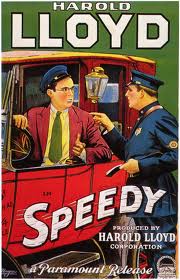
Silent Masterpiece — Harold Lloyd's Speedy at the Julien Dubuque Int'l Film Festival

Taking us back to the innocent and playful origins of film, Harold Lloyd's Speedy is a silent masterpiece of clever theater and hilarious fun.


View 1962 interview with Harold Lloyd, along with several clips of other silent film stars and some discussion of why Lloyd was different from Chaplin.


As the marquee Saturday night event of the four-day Julien Dubuque International Film Festival, Speedy did for the audience what films rarely do: it got them laughing out loud and talking to each other afterward. The sense of community it engendered was as inspiring as it was surprising. 

Set to an original score and meant to be seen with a live orchestra, the story is of a penniless but enterprising working-class person in New York City, a believable character who must overcome financial odds to protect his father's business and win the woman he loves.

His pursuit of work gets him a job driving a cab, which earns him his titular nickname, and gets him into all sorts of trouble. The production quality of the scenes racing through Manhattan is high; they are almost breathtaking and would have been extremely difficult to film.
My children followed the story and most of the humor, some of which is three-stooges style slapstick and some of which is quite subtle and clever.
They especially liked the cameo appearance of Babe Ruth, who acts in remarkably convincing fashion.


View scene with Babe Ruth in cab (it won't be as good here as the live orchestra!)

Speedy works as a film because of its humor, but also in the way it pays homage to New York, and to the underdog. There is a universal story here about struggling with the powers that be, and doing so with flair and grace.

Kudos once again to the the JDIFF for their inclusion of this important piece of film history, and having everyone be so delighted and entertained in the process.


Sunday, April 7, 2013

Vidal Sassoon — The 2013 Julien Dubuque Int'l Film Festival

Sometimes we come across someone who is so inspired, so driven at the core of their being, that they can influence us in an area in which we might not normally have any interest. Such is the case with the seminal persona of Vidal Sassoon (1928-2012).


DEPTH: 5
PRODUCTION: 5
NARRATIVE: 5


This fascinating documentary is a multi-faceted portrayal of a man whose life was dedicated to hair, who gave women a new way of thinking about their own self-image and their very role in life.


The most reproduced image of a hairstyle ever
VS wanted to eliminate the superfluous, get down to the basic. In doing so he created a look no one had ever seen, and one that still looks contemporary.
The 5-point cut


A survey of recent glamor magazines confirms that the 5-point cut design VS pioneered fifty years ago is still alive and even ahead of its time.

"Hairdressing needs to change in response to architecture." VS was influenced by the minimalism and geometry of the Bauhaus school. "Geometry, angles, and shapes must be suited to the bone structure" of the woman's face.

He would convince clients to do things his way, not theirs. "Don't you want to give me what I want?" they would ask. "Listen," he would say, with a whispered, almost hypnotic intensity,
"People who go out on a limb, who really get to who they are, they don't do things the way they were used to."

Haircutting was about liberating the self, allowing one's own inner expression to shine through. It allowed women to escape from the weekly perm-and-puff tending to their hair. Sassoon's influence came to the fore in the 1960's when there were many other movements afoot changing the role of women.

"You can't go through life on a fairy tale." VS's daughter overdosed and died on New Year's Day around five years prior to the documentary (around 2005). He reflects soberly on this downturn in an otherwise star-struck life. VS took lessons from an acting coach, to get over his cockney, to appeal to a wider, more sophisticated audience and clientele. He and his first wife were very good at being on television and eventually found themselves in Los Angeles with a talk show and a $400 million-dollar product line to market.
The move to L.A. and the plunge into product sales was "good for product, bad for family." This unfortunate story line seems to be so common among those who have his level of energy and creativity - one wonders why this has to be so. He reflects that he went away from what was truly at the core: cutting hair, interacting in real time with the living sculpture of a woman's face.

His advice for anyone who is an artist: it will take more time at your craft to master it, even putting in 14-hour days. Nine years of preparation, he says, went into the discovery of the five-point cut. And this: "Most of my progressive thoughts and attitudes happened when I was alone."

He kept very fit; swam and was extremely flexible. He had a generous heart; a surprising moment in the documentary comes in the telling of his finding a way to build 23 homes in New Orleans after Katrina.
The energy flowing from the Vidal Sassoon salons—originally just one in London, then in New York, now around the world—has influenced a generation of stylists and teachers. He touched the lives of countless women who discovered new way of looking at themselves, their own potential.

The world was richer for his life and presence, and one cannot but come away from this inspiring documentary with a sense of optimism and renewed dedication to their own potential.

We might see our image in terms of our hair, but perhaps more importantly, we can see it whatever craft we might be pursuing, and give to the world as he did.

Tuesday, March 26, 2013

Power, Strength...and Love — My Architect, A Son's Journey

"It gave us an identity, it gave us hope," says the teary-eyed Bangladeshi of Louis Kahn's capital structure, built there shortly before he died.


DEPTH: 4
PRODUCTION: 4
EDITING: 3
NARRATIVE: 5
DEMAND ON VIEWER: Moderate


Louis I. Kahn was one of the most important architects of the 20th century, influencing many of the other now great names in the field, such as I.M. Pei. This documentary, made by his son, magnificently captures his essence.


Like an ancient ruin, the capital of Bangladesh is at once a larger-than-life enigma, a thing of great strength and beauty, and a testimony to a civilization. Unlike an ancient ruin, however, this building gave a living civilization—one of the poorest countries in the world—a place to house its government.  


And yet, Kahn died shortly afterward. His son, Nathaniel, was only 11. As an adult he made this documentary to find his dad. He wanted to find out: Who was he? Who were the women in his life? 

How did he create such massive, and yet profoundly spiritual buildings? Why, if he loved humanity enough to contribute these buildings at great cost to himself, did he not seem to be able to provide a stable home environment, or be committed to one woman? 

This film is remarkable for its radically honest portrayal of a father, lover, artist, and visionary, by a person who might not have been up for such a task: his son Nathaniel. His personal journey adds interest to the narrative and keeps it from becoming a dry art history lecture.


The Salk Institute is a highlight. Every office in this building for biologists has an unobstructed view of the ocean. The film lets us discover the spirituality of the place, as Nathaniel explores it.

Remarkably, Nathaniel also interviews Kahn's wife, as well as his own mother (who was another lover of Kahn's), and manages to ask some very hardball questions. The pain is evident. But so is the love, and the dedication to Kahn.

Kahn is an ugly man, with prominent scars crossing his face. But his artistic vision and charming personality were such that he was able to attract women not only to be paramours but to work tirelessly with him on the buildings.

Kahn was very hard to work with, from a business perspective. He spent millions on his projects, and died broke. He frustrated the contractors by constantly interjecting new ideas. He was addicted to his work and spent endless hours away from his family. He was stubborn and would fight with people if he disagreed with them.

He once proposed a series of parking structures for the city of Philadelphia. The idea was that people could leave their cars and walk. It was rejected. A very humorous moment in the film comes when the former mayor defends that rejection, utterly insulting Kahn's lack of practicality.

This film will challenge your notion of art and architecture, it will challenge your notion of marriage, it will challenge your notion of purpose. If at first you find the buildings not to your taste, give it time, by the end of the film you might end up a convert. Kahn's creations are a testament to love and power. They leave a legacy of a visionary artist on the world, and a vivid personality of a father on a son.

Saturday, February 23, 2013

A Meal for the Senses — Django Unchained

Nothing less than a modern opera, Django Unchained is a towering work of art, a true 21st-century Western, creating a legendary character for our era.


DEPTH: 3
ACTING: 4
PLOT: 4
ORIGINALITY: 3.5
PRODUCTION: 5
ENTERTAINMENT: 5
DEMAND ON VIEWER: Moderate to high, for violence and length
OVERALL:  Recommended


This film is a work of art and a real contribution to the art form that is film. It combines carefully placed, stunning visuals with exceptional aural sound experience. This is typical for Tarantino, but what is unusual here is the way he applies this to the genre of Western, and combines it with the creation of an epic character.

From the opening credits, a well-selected and operatic soundtrack helps set the theatrical backdrop for this latest of Tarantino's universes. He has a knack for selecting just the right tune: "Django" accompanies the gang of slaves at the beginning, and "Moving Me Down the Highway" by Jim Croce accompanies, not a highway, but a snow-clad vista shot in the mountains of Wyoming. The music is perfect for the mood of the film: "and I'm gonna go there free."


DiCaprio puts in a fine-tuned, entertaining performance; his flair and timing are drawn out by Tarantino in way I haven't seen before.

Foxx is magnetic mostly because of his costume. In its own right a very worthy art form.

Samuel Jackson is once again at his rhythmically  intoned best as the aged butler who tries to keep Django down, reminding us that sometimes your worst enemies are from your own camp. This film, like Pulp Fiction, will be worth watching over and over just to enjoy Jackson's humorous and witty dialogues.

The most intriguing performance is turned in by Christopher Waltz. His beautiful German accent—a tonic to the rough southern drawls—is a nod to diversity, that with the coming of global diversity comes more freedom.

Waltz' character, Dr. King Schultz, is a great choice for a name, because he gives Django his chance at a dream, at freedom. Even though King is a mercenary, he carries enlightenment-age ideals with him and seems to want to promote a more rational way of life. Unfortunately for the film, and for Tarantino, Schultz is not allowed to carry his higher self through to the end. "I'm sorry, I just couldn't help it," he says, after giving in to violence one last fatal time. Is this Tarantino speaking a confession?

One gets the feeling of catharsis in this film. Racial catharsis, of finally arriving at a time when those without power suddenly have it before them, and take it lustily. But is this the way we really want things to be? The bloodletting and gun-firing is perhaps a staple of westerns, and certainly of Tarantino, but one wishes there weren't quite so many bullets. The story would have still had its magic without being an advertisement for the NRA.


THIS IS A FUNNY, very entertaining, exceptionally dramatic film. If art is meant to take us someplace else, someplace we won't forget, Django hits the mark. At the same time it will provoke discussion simply because of its full-frontal assault on white supremacy (the scene with the bags over the heads of the KKK deserves special mention for its Tarantino-esque black humor - watch it for a good laugh). See this film, it will leave you a bit breathless, but it will also enrich you with a full meal for the senses.


Wednesday, February 20, 2013

Movies in The Age of Obama


DEEPER EXTRA: MOVIES IN THE AGE OF OBAMA

Michael Witte's artwork in the New York Times depicts, clockwise from top left, Zero Dark Thirty, Django Unchained, The Help, Lincoln, and the Avengers.

READ MORE ABOUT MOVIES IN THE AGE OF OBAMA

DEEPER RESPONSE: Are these film inspired by the era of Obama? What does it say that so many films seem to portray African Americans as legendary figures in a prominent film roles? Or that the overtly political films such as Lincoln seem to carry overtones of Obama?

Read Times Article, Black Characters Are Still Too Good Too Bad Or Invisible - on the current state of race in film. Is the review of Django fair in this article? I don't think so - the critique of Django as being a fantastical character is not in keeping with the genre. A bit like saying Clint Eastwood's westerns were too fantastical.

It is true that we need more realistic and complex portrayals by African American actors, but leveling that charge against Django Unchained is perhaps expecting it to be something it was not. Still, it is a point worth taking that black actors are still props for white actors in many films, even ones that purport to be about the black experience.

Sunday, February 17, 2013

Runaway Magic — Silver Linings Playbook

Excelsior! A film about the positive, clear-eyed view of life, and celebrating those closest to the heart.


DEPTH: 4
ACTING: 5
PLOT: 5
ORIGINALITY: 5
ENTERTAINMENT: 5
PRODUCTION: 5
DEMAND ON VIEWER: Mild
OVERALL: Recommended


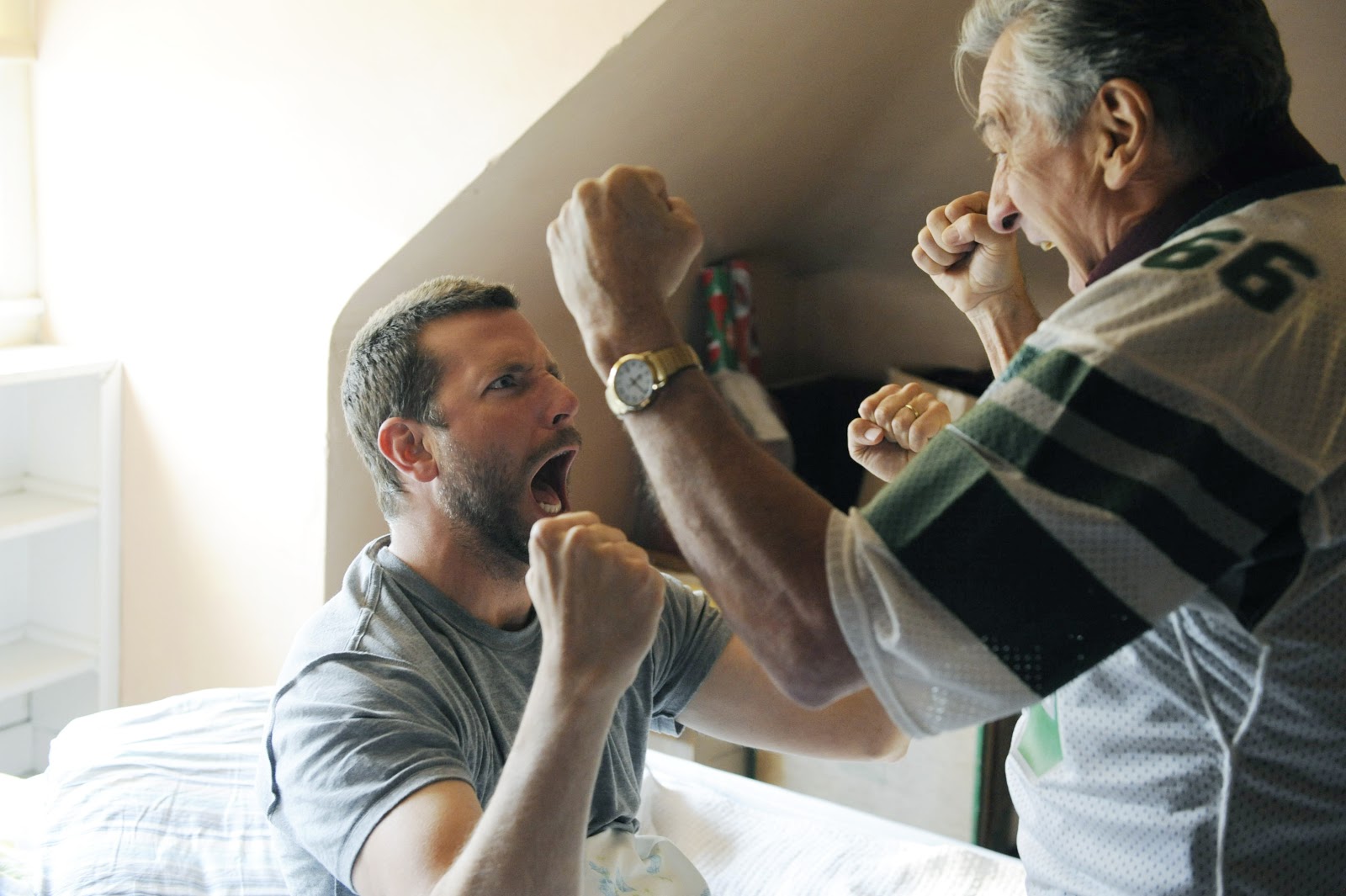
 Ostensibly about football, this film ended up being just as much or more about dance. It rallied around team sports and family, but also around artistic expression as a way of healing and finding oneself.
Jennifer Lawrence ran away with this film. Her magic carries the story along, and while there were four oscar nominations, I think she was the clear winner.


The acting ensemble including DeNiro was remarkable, and it helped create a real father-son dynamic. It also helps the film reach across generations. I found myself wanting to write a letter to my father, and I did so after coming home from this film.

I was engrossed in the moments created by the film, the specific-ness, the quirkiness of the family lingo, the strange personality traits that somehow go from annoying to lovable.

The real questions in this film were about how we interpret ourselves, and Tiffany (Lawrence) helps lead the way in asking, What about all that muddy, slutty, bad stuff? Do we deny that about ourselves, or do we learn to embrace it? Can we stick together no matter what? 

DEEPER RESPONSE: What do you think of the dance element in the film? How is that important as a therapeutic method, where others may not have worked?